Zizek used to argue that the Matrix wasn’t so much about uncovering truth, but uncovering fantasy. That the initiate doesn’t really want to escape the trappings of his simulated existence, so much as have a world of escapism to retreat to. (We should now add one’s Wonderland can easily be 4chan.) “I want a third pill,” Zizek exclaims in his movie, “a pill which will enables me not to see the reality behind the illusion, but the reality in illusion itself”. He was fun while it lasted.
What then would happen if Thomas Anderson ingested both pills Morpheus offered him? The mentor says: “You take the blue pill–the story ends, you wake up in your bed and believe whatever you want to believe.” The Red Pill necessitates belief because it carries truth; the Blue Pill comes with a choice. Purple Pill Thomas would wake up in a world he knew it was fake, he would spot the glitches and the agents, who would look back at him, his eyes would be forever haunted with the knowledge of the human battery farms, his fingertips would look for the plughole missing from the back of his head. The rabbit hole would be always there yet never there, a terror on the periphery. The One would have been reduced to zero.
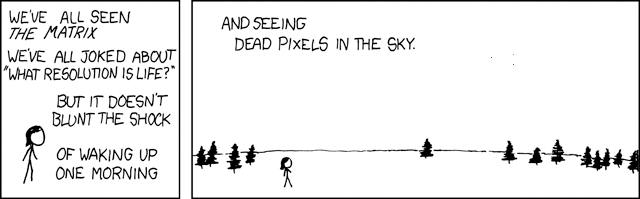
This strikes me as a fairly conventional horror story, but it might just be a beginning. Over time Thomas might learn to harness the knowledge and outplay the Matrix. Patterns of meaning might emerge that enabled him to win the stock market. He might locate “cut content” neighborhoods that time or physics don’t apply (Animatrix does this) and live forever. Over time he would learn to dream the green source code, and hack reality directly. He might speculate a level of reality further even than Zion, like the yellow realm blindness reveals to him in Revolutions. Zion operatives would acknowledge him as a tentative ally, not unlike the Merovingian. He’d be the most peculiar creature of the Matrix, because by playing the computer he’d be even more a part of it than the Unpilled. He’d be a human in the class of the program-characters.
Purple Pill Thomas would then find his becoming in the occult space between paranoia, fantasy, and intention. He would overcome the madness of trauma to emerge as a kind of magus, as in Wilson’s Chapel Perilous. Perhaps this is closer to Zizek’s “reality in illusion,” and implies a post-post-truth approach, an awareness that we’re always to some extent choosing our belief structures. The chaos of information only makes it easier to get lost in these structures, to construct endless Zions, an ecosystem of echo-chambers. But the worst choice for Thomas might have been to reject any pill, to subsist in a limbo of ambiguity with not even the comfort of telling himself it was all a dream.
Here’s hoping there is life for a Matrix sequel. The Wachowskis find themselves before a unique pop culture challenge. Our formative cyber-gnostic epic has been co-opted into conspiracy theory and hate speech. The Internet meant vastly different things then than it means now; it pointed no way to utopia but rather to tribalism. Perhaps the yellow realm will turn out to be not an approach to some machinic divine but the connective tissue between these countless variations of Zion, each as true as the next one and each as much a product of the Matrix as the Matrix is of them. The trans-sisters should contend with the fact that revolution doesn’t mean escape–it was never an option for collective humanity to wake up under ravaged skies. Instead, all of us in our little Zions should learn to get along, as that is the only way to reclaim and rebuild the Matrix: the only outcome that truly matters.
 the Budafoki amended
One thought on “The Purple Pill”
Comments are closed.