[Read in Greek, so the few quotes are approximated]
[Content warning: historical detail may resonate in manner disheartening to modern Greeks]
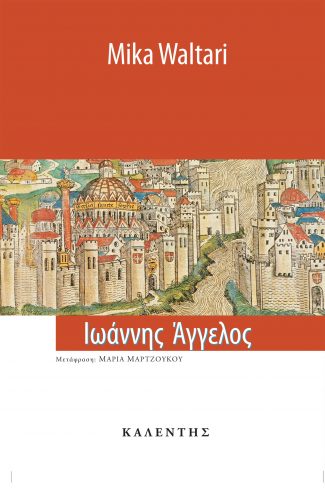
Part of the reason this doesn’t make 4 stars is just my own differing expectations. I came for the forbidden romance set against falling Constantinople, and halfway through I found myself in the middle of battle, never to come out. I just wasn’t expecting to go down such a standard historical fiction road. In hindsight, the book’s age and its appeal to an international readership should have been telltale signs–there just has to be a flagship dramatization of Christian Europe’s great turning point in the historical novel market. Nevertheless, I think that when books turn out different than what we expected they can and do win us over anyway.
Johannes Angelos isn’t one of these cases, though it is catnip to romantics and up to a point I was eagerly eating it up. The hero’s nostalgic return to the Greek people as their first city crumbles, his clear-eyed death wish to be swept along with her by the sheer inevitability of history, lends his love affair doomed urgency. It’s wham-bam-illicit first date with the ma’am stuff, and dialogue that would have given us a migraine in any other setting just sticks; every fated proclamation of love matters.
Waltari’s Greeks are, of course, perfect romantic outsiders, an ancient, spiritual, and endlessly proud people beaten to their last inch, abandoned by anyone without an angle to loot what they’re supposed to salvage–basically everyone, that is. Mercifully, however, though their eyes are filled with “infinite melancholy”, Waltari also writes accurate contradiction into them. Though keepers of a dying light, the citizens of Constantinople are backward in matters of society and sex; though apprehensive of their idolatrous legacy, they also despise it. Insisting in the city’s favor with the heavens, they pray for a miracle to the bitter end. Their clergy, meanwhile, are already looking for their place under the Sultan.
The novel offers satisfying history. Sheets are spread along the way of noblewomen, shielding them from prying eyes. The formidable Giovanni Guistiniani threads his beard with imperial red-and-gold, that the locals might like him better. The Peran region’s nominal neutrality gives grounds for machinations in every sphere: war, commerce, politics, espionage. The besieged walls in a state of continual renewal, stuffed with mattresses and all sorts of debris, spell bleak military law for the famished citizens. Johannes remembers the dashed hopes of the Council of Florence and his master Nicholas of Cusa feverishly dismantling Aristotle, the point Waltari shows as the beginning of the end for philosophy as well as the creeping onset of a barbaric moral relativism; in other words, the beginnings of modernity.
The novel’s core (romantic) historical theme, however, that along with Constantinople fell a pre-modern world whose spiritual and philosophical foundation lent it morals and an essential humanity, is complicated by the positioning of Mehmed II as avatar of that oncoming storm of modernity and moral relativism. (The all-powerful Sultan, we’re told in the book’s gutting denouement, spared the clergy but not the philosophers. But what tyrant likes philosophers?) I don’t know if Waltari’s research somehow necessitated this; it just seems to be his own reading of history. As such, it just wasn’t very convincing*.
*(Another flaw is that Waltari draws on an outdated view of Platonist Byzantium vs. Aristotelian West. Of course, an old book cannot help being dated in some respects; however, it should be noted that contemporary scholarship shows this to be far from the case [see: Siniossoglou, Kaldellis, Laiou])
The engineers, on the other hand, make for more interesting avatars, immersed as they are in their business of abstracting war down to mathematics. Johannes Grant, who toys dangerously with Greek Fire throughout, is I think my favorite character. The bit players, in general, seem to get the cake, the common folk I wanted to see more of. Charikleia’s heartbreaking tending to a dying young Janissary, even Mihail’s wretched servility. There’s much to like in Waltari’s novel, down to the faint supernatural touches and the spoiler cleverly hidden in the title.
In the end, however, Johannes Angelos is a novel whose unyielding fatalism left me cold. It’s not that he takes no prisoners in documenting the endless atrocities–that cannot be bartered, history only flows the one way. As a modern reader, however, I am used and desensitized to it. Taking inventory of the catastrophe is one thing. I want the author to also stake out shelter from the storm, for their sake and mine.
What that means is that Waltari’s star-crossed lovers deserved better. Why didn’t Waltari have Anna, who claims to be “just a woman, who wants to live” convince Johannes to do just that, anywhere, as anyone? Can shelter be found anywhere else, once we’ve shed all metaphysics? I don’t think that, by the end, I had much respect for Johannes’ death wish. He made sure all the honor had been taken out of it, then he did it anyway, and he took poor Anna with him.
 the Budafoki amended