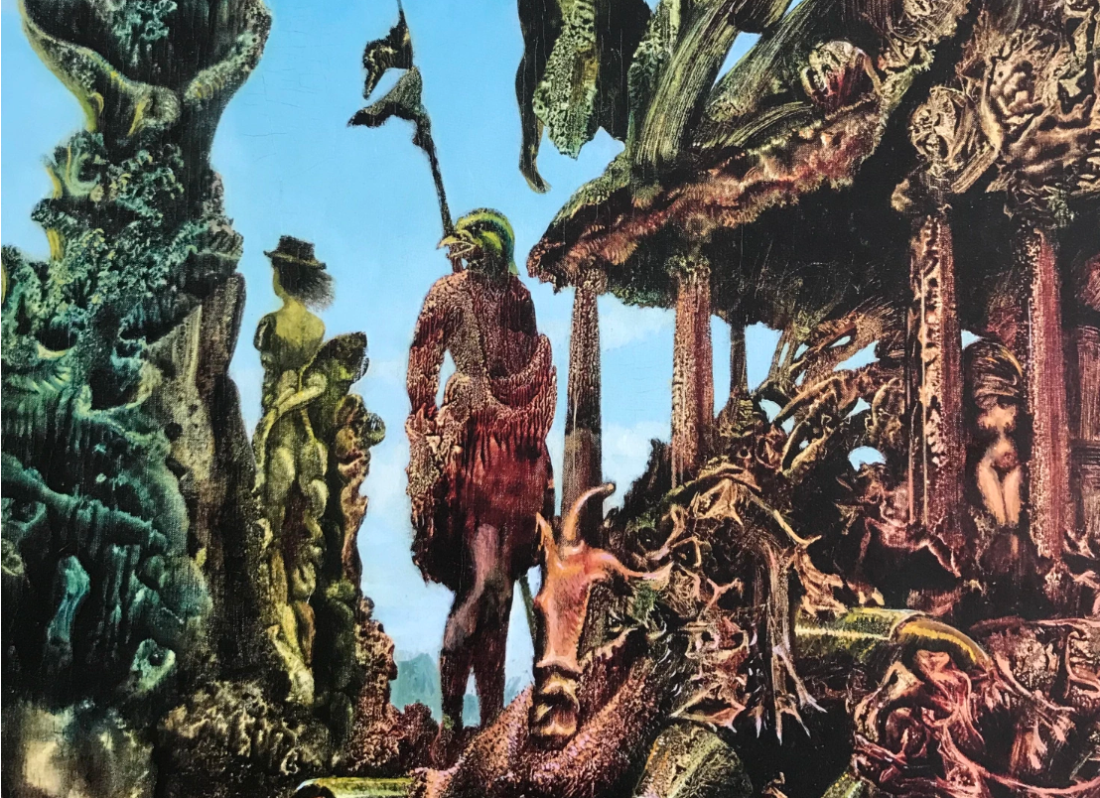
MONSTERS AND MYTHS: SURREALISM & WAR IN THE 1930s AND 1940s: Come for the glorious gatefold reproducing Europe After The Rains II (detail below) in its entirety, stay for four essays diving deep into Surrealism as an interwar movement, one that drew on WWI trauma (some, like Ernst, were veterans) and gave dark omens of the catastrophe to come. Largely side-stepping the more apolitical Dali in favor of Masson, Ernst, and others, the authors trace their subjects sensing up the chaotic forces simmering in the collective psyche, funneling the unstable era into monstrous and mythic imagery. The channeling was sometimes conscious –the world was, after all, falling apart around them, with some of them targets of persecution–and sometimes less so, as in Ernst’s ‘decalcomania’ paintings, in which the artist used glass on wet paint to essentially unearth his strangely organic forms. In time, the relatively harmless charge of a bouncing Loplop or of The Barbarians find its way into the hell of Guernica (with its broken bull) or Masson’s Tower of Sleep. The book injects new relevance to the movement, as the parallels between the historical moment of the painters and that of its authors are known. If you thought Surrealist painting had nothing for you but fun and games, I hope you splash out and give this a chance.
 the Budafoki amended